Gap 1
Fragmented information
Environmental, financial and regulatory data are dispersed across different sources, scales and systems.
- APA
- ICNF
- INE
- IPMA
- Copernicus
- EEA
- ENCORE
ECONODE integrates environmental, business and regulatory information to help companies understand their relationship with nature and translate environmental exposure into economic insight and better decisions.
Three gaps sit between environmental information and business decisions. Each one compounds the next.
Environmental, financial and regulatory data are dispersed across different sources, scales and systems.
Knowing that a company is exposed to water stress, biodiversity loss or flood risk does not reveal what that exposure means for its activity. The assessment requires combining:
Ultimately, companies need to be able to answer:
ECONODE transforms environmental data into economic intelligence to support business decisions, through three core functions.
ECONODE brings together information from different sources and relates it to each company's activity and location.
ECONODE seeks to understand the relationship between business activity and natural capital.
ECONODE translates environmental information into economic metrics that can support investment, risk management and strategy.
Each assessment starts where the company operates and ends with figures that can inform a decision.
Contextualise the company through its location, activity and relationship with the territory.
Identify dependencies, impacts, risks and opportunities related to nature.
Translate environmental exposure into risk indicators and economic metrics.
From territorial characterisation to economic decision-making.
Understand your relationship with nature.Quantify the implications.Make better decisions.
Water availability, soil, climate, biodiversity and the condition of the surrounding territory all shape how a business performs. Yet the information describing these conditions is produced by environmental agencies, statistical offices and scientific programmes, in formats designed for monitoring rather than for business decisions.
This creates a gap. Companies can access environmental data, but rarely see what it means for their own activity, their costs or their exposure to risk. ECONODE exists to close that gap by relating environmental information to the specific company, the place where it operates and the economic consequences for its business.
Climate, water, biodiversity, land use and other indicators from public sources.
The data is placed in the context of a specific site and economic activity.
What the activity relies on from nature, and how it affects it.
Where exposure could affect operations, and where it could create value.
Exposure expressed through indicators and economic metrics.
Evidence that can inform investment, risk management and strategy.
The objective is not to produce another sustainability report. It is to connect environmental information with the economic reality of the company.
ECONODE brings these inputs together so the resulting analysis can support concrete business decisions.
ECONODE's services are designed to meet the needs of organisations from SMEs to large companies, regardless of their sector or industry.
Nature and environmental dependencies are progressively entering business management.
Portuguese, European and global sources make it possible to build a contextualised view of each company.
Environmental information still needs to be translated into risk, economic impact and decisions. In Portugal, we see room for solutions that integrate all three.
See how the model turns this reasoning into a structured assessment.
The ECONODE platform is built around an analytical model that connects environmental information with company-specific economic implications. Dashboards and reports are how results are presented; the model is what produces them.
The model is organised in four stages. The first three structure the assessment. The fourth describes where the project is heading: from assessment towards decision support.
Contextualise the company in its territory.
Geographic context matters because environmental risks and natural capital are spatially dependent. The same activity can face very different water availability, climate hazards or biodiversity sensitivity depending on where it takes place.
Understand the relationship between the activity and nature.
The conceptual framework of this stage is informed by established methodologies, including TNFD's LEAP approach, SBTN and Natural Capital approaches.
Express exposure in terms a business can act on.
The long-term objective: moving from assessment towards decision support.
The platform should eventually help companies understand:
A simplified view of the analytical architecture, from raw data to decision support.
ECONODE has researched these frameworks and uses concepts associated with them to structure its approach.
A framework for identifying, measuring and valuing an organisation's impacts and dependencies on natural capital.
The Taskforce on Nature-related Financial Disclosures and its Locate, Evaluate, Assess, Prepare approach to nature-related issues.
The Science Based Targets Network, which provides guidance for companies setting targets for nature.
The European Sustainability Reporting Standards applied under the EU Corporate Sustainability Reporting Directive.
These frameworks are presented as methodological and regulatory context informing the project. They are not certifications, and ECONODE does not claim full compliance with them.
ECONODE combines Portuguese, European and international sources to build a contextualised picture of the environmental, economic and territorial conditions surrounding a company.
The two layers work together: Portuguese institutional data characterises the local context, while European and international sources add complementary context, risk and biodiversity information, and methodological support.
Select a theme to see which sources contribute to it.
Data specific to Portuguese territory, used to characterise the environmental, economic and territorial context of each company.
Context, risk, projections and reference methodologies that complement the local layer.
The database is not simply a collection of datasets. The goal is to structure and relate the information so that environmental indicators can eventually be associated with a company's location, activity and exposure.
ECONODE — Natural Capital & Sustainability Advisory is being built by two co-founders who combine economics and computer engineering. The project is currently at the proof-of-concept stage.
This page sets out what has been done, where the project stands today and what comes next. The roadmap describes planned development, not capabilities that are already complete.
These stages describe the project's planned development. Only the first is currently under way.
Implementation and organisation of the database.
Interactive dashboard demonstrating data relating to the local ecosystem.
Connect environmental data with the economic impact of natural capital on each company.
An in-house model focused on measuring and eventually predicting risks that may influence client productivity over the short, medium and long term.
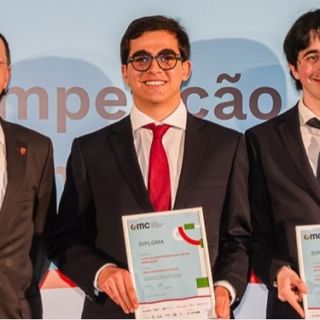

“ECONODE is more than a business opportunity in an under-explored market. It is also our chance to make a difference on an increasingly over-exploited planet, facing a climate that is ever more extreme and unpredictable.”
João Rodrigues and João Luz